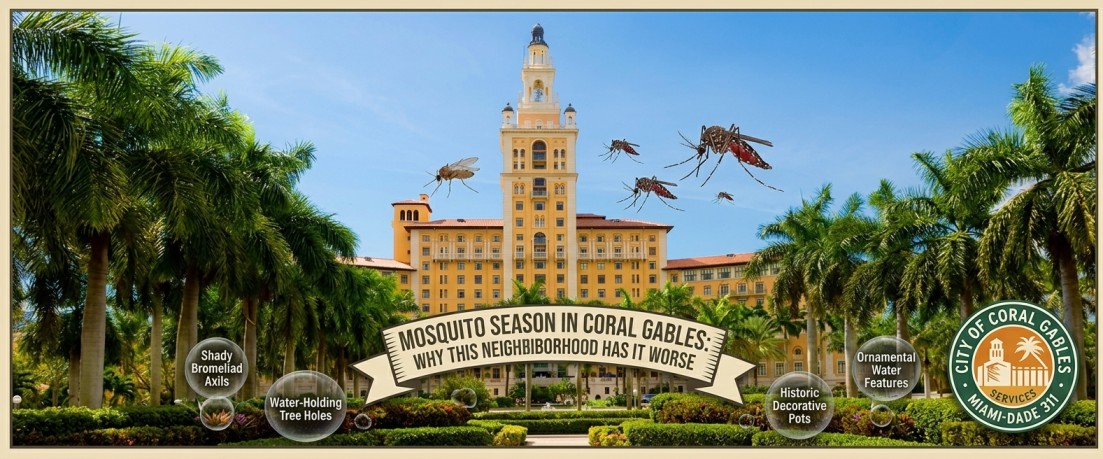
Mosquito Season in Coral Gables: Why This Neighborhood Has It Worse (And What to Do About It)
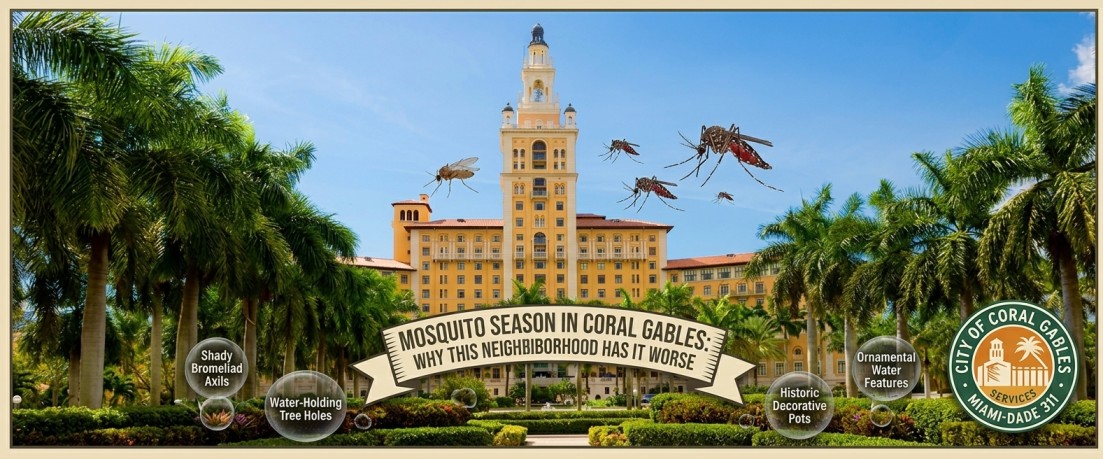
Coral Gables is one of the most beautiful neighborhoods in South Florida. The mature banyan trees, the historic waterways, the lush landscaping -- it's exactly why people pay a premium to live here.
It's also exactly why mosquitoes love it.
The same features that make the Gables gorgeous -- dense tree canopy, ornamental bromeliads, coral rock walls that trap moisture, and proximity to waterways like the Coral Gables Waterway -- create an ideal mosquito breeding environment. And if your neighbors aren't treating their yards, even the best individual efforts only go so far.
Here's what's different about mosquito control in Coral Gables compared to the rest of Miami-Dade, and what actually works.
The Tree Canopy Problem
Coral Gables is famous for its tree-lined streets. Live oaks, banyans, mahogany trees, and royal poinciana create a continuous canopy across entire blocks. The city even has strict tree protection ordinances that (rightfully) preserve this urban forest.
But that canopy also:
Traps humidity underneath. Mosquitoes thrive in humid, still air. A dense canopy reduces airflow and keeps the microclimate underneath wetter and more humid than open areas.
Creates deep shade. Standing water in shaded areas evaporates much slower than in direct sunlight. A puddle in your sunny driveway might dry in a day. The same puddle under a banyan tree can last a week -- plenty of time for mosquito larvae to mature.
Produces leaf litter and organic debris. Decomposing leaves in gutters, tree holes, and low spots provide nutrients that mosquito larvae feed on. It's not just water they need -- it's nutrient-rich water.
This is why Coral Gables homeowners often notice more mosquitoes than friends in newer neighborhoods like Doral or Kendall with less mature landscaping.
Bromeliads: Beautiful and Dangerous
Walk through any Coral Gables neighborhood and you'll see bromeliads everywhere -- in landscaping beds, mounted on tree trunks, growing wild on branches. They're practically a signature plant of the area.
They're also miniature mosquito nurseries.
Tank bromeliads -- the varieties with central cups that hold water -- are known breeding sites for Aedes aegypti and Aedes albopictus, the two mosquito species most likely to bite during daytime and most likely to transmit diseases like dengue and Zika. According to the University of Florida's Institute of Food and Agricultural Sciences (UF/IFAS), these mosquitoes readily colonize ornamental bromeliads, and a single large bromeliad can produce dozens of mosquitoes per week.
During the 2016 Zika outbreak in Miami, ornamental bromeliads were actually removed from public gardens over concerns they were contributing to the spread. While the science on that particular decision is debated, the basic fact isn't: bromeliads hold water, and water breeds mosquitoes.
What to Do About Bromeliads
You don't need to rip them out. Here's what works:
Flush bromeliads weekly. Use a hose to blast water through the central cup. This dislodges larvae and eggs.
Apply BTI granules. Bacillus thuringiensis israelensis is a naturally occurring bacterium that kills mosquito larvae but is safe for plants, pets, and people. Sprinkle it into bromeliad cups every 30 days.
Choose varieties that hold less water. If you're planting new bromeliads, select species with tighter leaf rosettes that accumulate less water.
Copper pennies (pre-1982) or copper strips placed in bromeliad cups can inhibit larvae, though this is less effective than BTI.
Coral Rock and Historic Architecture
Coral Gables was literally built from coral rock. The Venetian Pool, the Biltmore Hotel, countless walls and facades -- coral rock is everywhere. It's gorgeous, and it's also porous.
Coral rock:
Absorbs and holds moisture in small crevices, creating micro-habitats for mosquitoes
Has natural holes and depressions that collect rainwater
Retains heat, which keeps nearby moisture warm -- ideal for rapid mosquito development
Older homes in the Gables also tend to have more architectural features that trap water: decorative fountains (sometimes neglected), rain gutters with complex routing, and aging drainage systems that don't move water as efficiently as modern ones.
The Waterway Factor
The Coral Gables Waterway runs through the heart of the neighborhood, connecting to Biscayne Bay. While moving water doesn't breed mosquitoes, the edges of the waterway -- where vegetation meets water, where tidal changes leave pools in mangrove roots -- are prime habitat.
Properties backing up to the waterway or within a few blocks of it typically deal with higher mosquito pressure. Add in the network of smaller drainage canals throughout the Gables, and you have a constant source of mosquito populations that individual homeowner treatment alone can't eliminate.
Why the "Neighborhood Effect" Matters Here
Here's the uncomfortable truth about mosquito control in Coral Gables: your yard is only as mosquito-free as your neighbor's yard.
Aedes aegypti -- the primary daytime-biting mosquito in South Florida -- has a flight range of roughly 150-300 feet. That means mosquitoes breeding in your neighbor's untreated yard, their clogged gutters, or their neglected pool cover are absolutely ending up on your patio.
This is especially true in the Gables because of the density. Lots are close together. The tree canopy connects properties. And many homes have the same landscape features -- bromeliads, mature trees, and coral rock -- creating a continuous mosquito-friendly environment across entire blocks.
What Actually Works
Individual spraying helps, but the most effective approach in a neighborhood like Coral Gables is coordinated treatment. When multiple homes on a block are treated simultaneously:
You eliminate breeding sites across the mosquito's full flight range
Treatment effectiveness compounds (fewer mosquitoes means fewer eggs means fewer mosquitoes)
The canopy becomes an asset instead of a liability -- treated foliage acts as a barrier
This is why referral programs like our Neighbor discount exist. It's not just a marketing play -- it genuinely makes the treatment more effective for everyone involved.
Barrier Treatments vs. Misting Systems
For Coral Gables specifically, the dense canopy and lush landscaping actually make barrier treatments particularly effective. Here's why:
Barrier spray is applied to vegetation, the undersides of leaves, shaded areas, and resting spots. In the Gables, there's a lot of vegetation to treat, which means more surface area holding the treatment product. A property with mature landscaping and tree cover holds a barrier treatment better than a bare lot.
Misting systems make sense for properties with extensive outdoor living areas -- which describes a lot of Coral Gables homes. If you have a covered patio, a pool area, or outdoor dining space you use daily, a misting system delivers consistent, automated protection without waiting for the next barrier treatment cycle.
The Bottom Line
Coral Gables' beauty and its mosquito problem come from the same source: mature trees, lush landscaping, historic architecture, and proximity to water. You can't (and shouldn't) change what makes the neighborhood special. But you can manage the mosquitoes that come with it.
The key is understanding that in a neighborhood like the Gables, mosquito control is a neighborhood-level challenge. Individual treatment helps. Coordinated treatment across multiple properties is what actually solves the problem.
Ready to take back your yard?
Coral Gables homeowners looking for professional mosquito control have several solid options. The top-rated local companies offer barrier spray treatments every 21 days, misting system installations, and some even offer neighborhood discounts when multiple homes on the same street sign up together.
See the best mosquito control companies serving Coral Gables
